
Hospital Injury Lawyer Atlanta, GA
If you or a family member was injured, assaulted, or harmed at a hospital due to inadequate security, staff misconduct, or negligent conditions, you’re dealing with a situation that shouldn’t happen in a place meant for healing. Hospitals are supposed to be safe environments. When security failures, abuse by staff, or dangerous conditions cause harm to patients or visitors, the facility may bear legal responsibility.
These are not typical medical malpractice cases. They’re premises liability and negligent security cases that happen to occur in hospital settings.
Our Atlanta, GA hospital injury lawyer has represented crime victims and their families for more than 40 years. We pursue civil claims against hospitals whose security failures, negligent hiring practices, or unsafe conditions allowed patients, visitors, or staff to be harmed. When hospitals fail their duties to protect people on their premises, we hold them accountable.
Why Choose Deitch + Rogers for Hospital Injury Cases in Atlanta, Georgia?
Decades Holding Institutions Accountable for Security Failures
 Gilbert Deitch, Founding Partner, graduated from the University of Tennessee College of Law in 1970 and has spent more than five decades representing victims of institutional negligence. A member of the Georgia Trial Lawyers Association, he has published premises liability articles in TRIAL Magazine and the Georgia State Bar Journal. His media appearances on NBC Nightly News and 20/20 have addressed victims’ rights in cases involving corporate and institutional negligence.
Andrew Rogers, Founding Partner, earned his J.D. from Georgia State University College of Law in 1988. A charter member of the National Crime Victim Bar Association, he holds the Highest Premises Liability Verdicts in Georgia for 2013, 2014, 2018, and 2019. Super Lawyers has recognized his work repeatedly.
If you need a premises liability attorney in Atlanta, GA, our firm has the experience to handle cases against major healthcare institutions.
Over $200 Million Recovered for Victims
Deitch + Rogers has recovered more than $200 million for victims of institutional negligence and violent crimes throughout Georgia. Our results include a $60 million verdict against an institution that failed to protect vulnerable individuals and a $46 million verdict involving institutional failures that led to death.
Every case depends on its specific facts. But our record demonstrates we know how to prove institutional negligence and achieve meaningful accountability against well-funded defendants.
Contingency Fee Representation
We advance all investigation, litigation, and expert expenses. Your family pays nothing upfront. Attorney fees come only from compensation we recover for you.
What Our Clients Say
⭐⭐⭐⭐⭐
“This is a great law firm! Everyone that works with the firm is dedicated to achieving the best outcome. I would definitely recommend the firm.” – Jo-Ann Taylor
Read more reviews on our Google Business Profile.
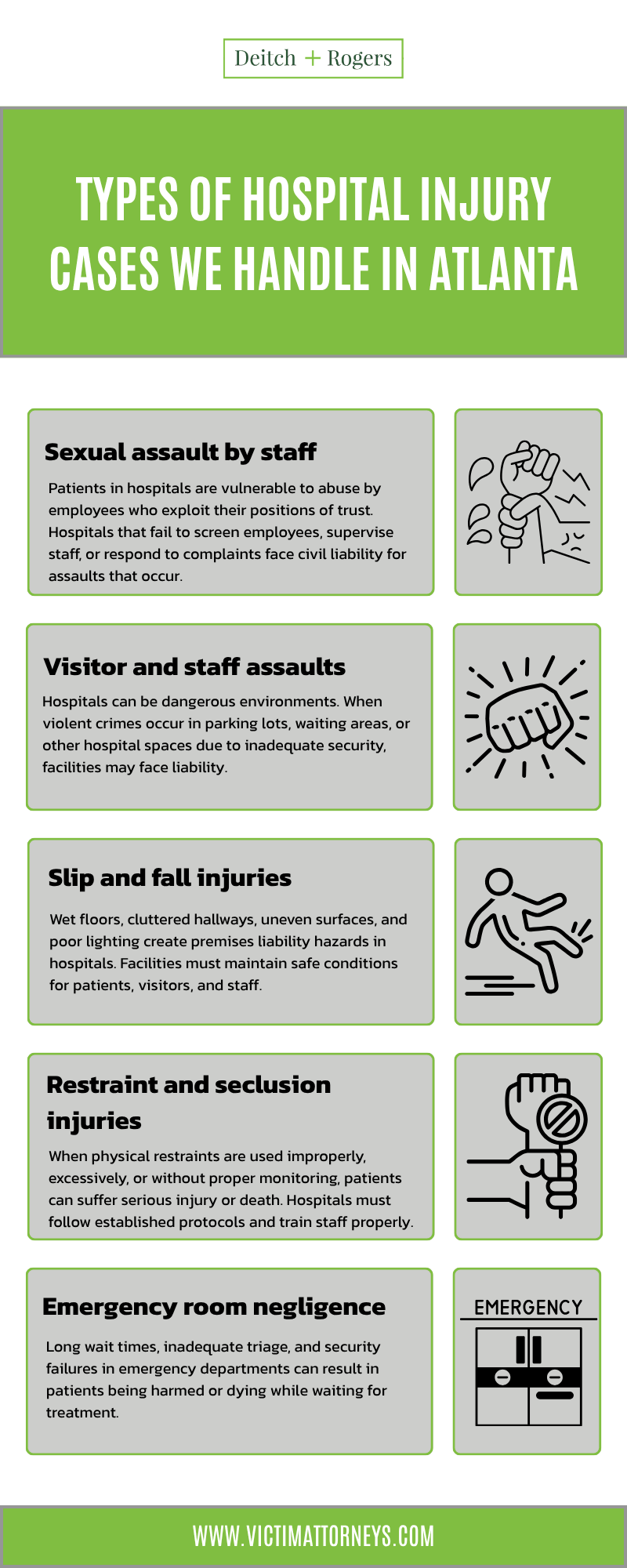
Types of Hospital Injury Cases We Handle in Atlanta
 Hospital injuries can occur across multiple contexts when facilities fail to maintain proper security and safety standards.
- Sexual Assault by Staff. Patients in hospitals are vulnerable to abuse by employees who exploit their positions of trust. Hospitals that fail to screen employees, supervise staff, or respond to complaints face civil liability for assaults that occur. Health care provider abuse is a serious and underreported problem.
- Patient-on-patient violence. Psychiatric units, emergency departments, and other hospital areas see violence between patients when facilities fail to assess risks, separate dangerous individuals, or provide adequate supervision. These injuries often indicate negligent security failures.
- Visitor and staff assaults. Hospitals can be dangerous environments. When violent crimes occur in parking lots, waiting areas, or other hospital spaces due to inadequate security, facilities may face liability.
- Slip and fall injuries. Wet floors, cluttered hallways, uneven surfaces, and poor lighting create premises liability hazards in hospitals. Facilities must maintain safe conditions for patients, visitors, and staff.
- Restraint and seclusion injuries. When physical restraints are used improperly, excessively, or without proper monitoring, patients can suffer serious injury or death. Hospitals must follow established protocols and train staff properly.
- Emergency room negligence. Long wait times, inadequate triage, and security failures in emergency departments can result in patients being harmed or dying while waiting for treatment.
Georgia Legal Requirements for Hospital Injury Claims

Georgia law creates duties that hospitals must fulfill to protect patients, visitors, and staff.
Premises Liability
Under O.C.G.A. § 51-3-1, property owners and operators owe invitees a duty of ordinary care. Hospital patients and visitors are invitees entitled to reasonably safe premises and protection from foreseeable harm, including criminal acts.
Statute of Limitations
Personal injury claims must generally be filed within two years under O.C.G.A. § 9-3-33. Cases involving professional negligence may have different deadlines. For sexual abuse of minors, extended deadlines apply under O.C.G.A. § 9-3-33.1.
Negligent Security
Hospitals have duties to provide adequate security measures, particularly in high-risk areas like emergency departments and psychiatric units. Factors include security staffing, surveillance systems, access controls, and staff training. Failures in these areas can establish negligence when crimes or assaults occur.
Regulatory Requirements
Georgia hospitals must comply with regulations from the Georgia Department of Community Health and federal requirements from the Centers for Medicare and Medicaid Services. Regulatory violations can support negligence claims.
What Damages Are Recoverable in Atlanta Hospital Injury Cases?
 Hospital injuries can range from minor to catastrophic. Georgia law provides compensation across multiple categories.
Economic Damages
Medical expenses include emergency treatment, additional hospitalization, surgery, rehabilitation, therapy, and ongoing care. Patients injured in hospitals often require treatment for injuries on top of the condition that originally brought them to the facility.
Lost wages compensate for income missed during recovery. If injuries cause permanent disability or extend recovery time significantly, lost earning capacity becomes recoverable.
Non-Economic Damages
Pain and suffering addresses physical discomfort and emotional trauma from injuries. Being harmed in a place meant for healing is particularly distressing and often causes lasting psychological effects.
Mental anguish covers anxiety, PTSD, depression, and fear of healthcare settings. Patients who experience trauma in hospitals may develop lasting reluctance to seek medical care, which can affect their long-term health.
Punitive Damages
Georgia allows punitive damages under O.C.G.A. § 51-12-5.1 when conduct demonstrates willful misconduct, malice, or conscious indifference to consequences. Hospitals that knowingly employed dangerous individuals, ignored repeated safety complaints, or systematically failed to provide adequate security may face punitive liability.
What Steps Should I Take After a Hospital Injury in Atlanta?
 Protecting your rights after being harmed at a hospital requires careful action.
- Ensure immediate safety. If you’re still in the facility and in danger, alert staff or call security. Request transfer to another facility if necessary.
- Get medical attention. Document all injuries through examination. If sexual assault occurred, consider a forensic examination to preserve evidence.
- Report to hospital administration. Request a written incident report. Get names of staff members involved and any witnesses. Ask for copies of documentation before discharge.
- Report to authorities. If a crime occurred, report to police. For abuse of vulnerable adults, report to Adult Protective Services. Regulatory complaints can be filed with the Georgia Department of Community Health.
- Document everything. Write down what happened, including dates, times, locations, staff involved, and witnesses. Photograph any visible injuries.
- Preserve evidence. Keep clothing or items from the incident. Don’t alter or wash anything that might be relevant.
- Request medical records. Obtain complete records, including incident reports, nursing notes, security logs, and all documentation related to your care.
- Identify witnesses. Other patients, visitors, or staff may have relevant information. Get contact information when possible.
- Don’t sign releases. The hospital may ask you to sign documents. Don’t sign anything without attorney review, especially anything that could affect legal rights.
- Contact a hospital injury lawyer. An experienced attorney can investigate the facility’s security practices, preserve evidence, and pursue civil accountability.
Atlanta Hospital Injury Infographic
Hospital Injury Statistics

Data reveals safety concerns at healthcare facilities that affect patients, visitors, and staff.
According to the Occupational Safety and Health Administration, healthcare workers face significantly elevated rates of workplace violence compared to other industries. Hospitals are among the most dangerous workplace environments for assaults.
Research from the Bureau of Labor Statistics indicates that healthcare and social assistance workers experience workplace violence at rates 5 to 12 times higher than workers overall. These statistics reflect both patient-on-staff and patient-on-patient violence.
The Centers for Medicare and Medicaid Services tracks deficiencies at hospitals that participate in federal programs. Inspection reports reveal ongoing problems with security, patient safety, and abuse prevention at facilities nationwide.
Studies published by the National Institutes of Health document that sexual assault and abuse by healthcare workers, while underreported, represents a significant patient safety concern.
The Georgia Department of Community Health oversees hospital licensing and investigates complaints. Regulatory enforcement actions can reveal patterns of facility failures.
Metro Atlanta has numerous major hospital systems serving millions of patients annually. The concentration of healthcare facilities means many Georgia families are potentially affected by hospital safety failures.
Emergency departments face particular challenges. According to emergency medicine research, violence in emergency rooms has increased substantially, affecting both patient and staff safety.
Atlanta Hospital Injury Lawyer FAQs
Can I sue a hospital for an assault that happened there?
 Yes. Hospitals can face liability for assaults that occur due to inadequate security, negligent hiring, failure to supervise staff, or failure to protect patients from known dangers.
Is this different from medical malpractice?
Yes. Hospital injury cases based on security failures, premises liability, or staff misconduct are different from medical malpractice claims involving treatment decisions. The legal theories, procedural requirements, and defenses differ significantly.
How long do I have to file a hospital injury claim?
The general statute of limitations is two years for personal injury. Extended deadlines may apply for childhood sexual abuse. Consult an attorney promptly to understand applicable deadlines.
Can I sue for sexual assault by a hospital employee?
Yes. Hospitals can face liability when employees assault patients, particularly when the hospital failed to screen the employee properly, ignored prior complaints, or failed to supervise adequately.
What if the assault was by another patient?
Hospitals may face liability for patient-on-patient violence when they failed to assess violence risk, failed to separate dangerous patients, or provided inadequate supervision.
How much does hiring a hospital injury lawyer cost?
We handle these cases on contingency. You pay nothing upfront and owe no fees unless we recover compensation. All litigation expenses are advanced by our firm.
What evidence matters in hospital injury cases?
Important evidence includes incident reports, security camera footage, security staffing records, employee personnel files, prior complaints, regulatory inspection reports, and your medical records.
Can I sue if I was injured in the hospital parking lot?
Yes. Hospital parking lots are part of the premises. Inadequate lighting, lack of security patrols, and poor surveillance in parking areas can support premises liability claims.
What if the hospital claims I was at fault?
Georgia’s comparative fault rules apply, but hospitals have independent duties to protect patients regardless of patient conduct. Facilities generally cannot shift responsibility to vulnerable patients.
Can I sue for emotional trauma without physical injury?
Georgia generally requires some physical impact, but assault cases typically involve both physical and emotional components. Fear of assault itself can constitute impact in some circumstances.
What if I didn’t report the incident right away?
Delayed reporting doesn’t bar claims, though it can complicate evidence gathering. Medical records and witness statements can help establish what happened.
Can family members sue if a patient died?
Yes. Wrongful death claims can proceed when hospital negligence contributed to a patient’s death. Georgia law specifies who may bring wrongful death claims and what damages are available.
What if the hospital is a nonprofit?
Nonprofit status doesn’t exempt hospitals from liability for negligence. Nonprofit hospitals have the same legal duties as for-profit facilities.
Can hospital employees sue for workplace violence?
Workers’ compensation generally covers workplace injuries, but civil claims may be available against third parties or in cases involving intentional misconduct. The analysis depends on specific circumstances.
How long do hospital injury cases take?
Duration varies based on case complexity and whether trial becomes necessary. Cases against large hospital systems may involve significant discovery.
Most Dangerous Locations for Hospital Injuries in Atlanta

Hospital injuries happen in specific areas and contexts. Understanding where problems occur helps families recognize when facilities failed their duties and identify patterns of negligence.
Patient rooms. This is where patients spend most of their time, and where a lot of injuries happen. Falls when patients try to get to the bathroom alone. Bed rails that entrap limbs. Call buttons that aren’t answered. Roommates who become aggressive. Infections from surfaces that weren’t properly cleaned. The patient room is supposed to be a place of healing, but understaffing and poor protocols turn it into a place where harm occurs.
Bathrooms. Hospital bathrooms cause a disproportionate number of patient falls. Wet floors. Patients who are weak, medicated, or confused trying to use the toilet without help. Grab bars that aren’t positioned properly. Call buttons that are out of reach. The combination of privacy expectations and patient vulnerability creates risk. Hospitals that don’t provide adequate assistance for bathroom trips know what they’re setting up.
Operating rooms. Surgical errors get the headlines, but those are malpractice cases. The premises liability issues involve equipment failures, fires from surgical instruments, burns from positioning on operating tables, retained surgical items, and infections from improperly sterilized environments. When OR injuries trace back to facility conditions rather than surgeon judgment, the hospital’s negligence comes into play.
Emergency departments. Overcrowded waiting rooms where patients deteriorate before being seen. Violence from other patients or visitors. Falls in triage areas. Delayed treatment that turns treatable conditions into catastrophic ones. ERs are designed for chaos, but that doesn’t excuse the chaos causing harm. Security failures in emergency departments allow assaults that hospitals should prevent.
Hallways and corridors. Gurneys left unattended. Equipment blocking pathways. Wet floors without warning signs. Patients wandering from their rooms and falling. Collisions between staff rushing with equipment and patients trying to walk. Hallways are transitional spaces that get less attention, but they’re where a lot of falls and injuries happen.
Parking garages and lots. Poor lighting that enables assaults. Uneven pavement that causes falls. Inadequate security patrols. Patients discharged at night who have to walk through isolated areas. Parking structures are hospital property, and the duty to protect patients doesn’t end at the building door.
Stairwells. Isolated spaces where assaults occur. Poor lighting. Steps that aren’t properly maintained. Handrails that are loose. Patients and visitors who use stairs during emergencies or when elevators are slow. Stairwells in hospitals are often neglected in security planning, creating vulnerability.
Labor and delivery units. Falls by laboring mothers. Injuries during transfers between rooms. Security failures that allow infant abduction. Medication errors during labor. These units deal with healthy patients going through a physically demanding process, and the focus on the baby sometimes means maternal safety gets overlooked.
Psychiatric units. Hospitals with inpatient psychiatric care face all the risks of standalone behavioral health facilities, plus the challenge of being in a medical setting that wasn’t primarily designed for psychiatric patients. Ligature risks, patient-on-patient violence, inadequate suicide precautions. Psych units inside general hospitals sometimes get treated as afterthoughts.
Cafeterias and food service areas. Foodborne illness outbreaks. Slip and falls on wet floors. Burns from hot beverages. Allergen exposure when ingredients aren’t properly labeled. Hospitals serve thousands of meals daily to patients, staff, and visitors, and food safety failures spread quickly through a vulnerable population.
Radiology and imaging departments. Falls from imaging tables. Burns from malfunctioning equipment. Contrast dye reactions that aren’t properly monitored. Patients left alone in imaging rooms who injure themselves. The technical focus of radiology sometimes means patient safety basics get overlooked.
Rehabilitation areas. Physical therapy gyms where patients fall during exercises. Equipment that malfunctions. Therapists who push patients beyond safe limits. These areas are supposed to help patients recover, but inadequate supervision and poor protocols cause setbacks instead.
Elevators. Doors that close too quickly on patients using walkers or wheelchairs. Gaps between elevator and floor that catch wheels. Entrapment incidents when elevators malfunction. Patients transported on gurneys that don’t fit properly. Elevators in hospitals see constant heavy use, and maintenance failures show up in injuries.
Loading docks and service areas. Patients and visitors sometimes end up in areas they shouldn’t access. Industrial equipment, delivery vehicles, chemical storage. When hospitals don’t properly secure service areas, people wander into hazardous spaces.
Waiting rooms. Violence between visitors. Falls from inadequate seating. Medical emergencies among people waiting who don’t get timely attention. Crowded conditions during flu season or other surge periods. Waiting rooms are part of the hospital experience, and the facility’s duties extend there too.
Important Local Resources for Atlanta Hospital Injury Victims
 If you or a family member was injured at a hospital in Atlanta, these resources may help. Deitch + Rogers does not endorse these organizations.
Grady Memorial Hospital – (404) 616-4307. Level I trauma center (for treatment at alternative facility).
Grady Rape Crisis Center – (404) 616-4861. 24-hour support for sexual assault survivors.
Atlanta Police Department – (404) 614-6544. Report crimes that occurred at hospital facilities.
Georgia Department of Community Health – Hospital licensing, inspections, and complaints.
Adult Protective Services – Report abuse of vulnerable adults.
Georgia Legal Services Program – Free legal assistance for qualifying individuals.
Disclaimer: Listing these resources does not constitute an endorsement by Deitch + Rogers. We provide this information solely for convenience.
Deitch + Rogers, Atlanta Hospital Injury Lawyer
1189 S Ponce De Leon Ave NE, Atlanta, GA 30306
Contact Deitch + Rogers
If you or a family member was injured, assaulted, or harmed at a hospital in Atlanta due to negligent security or institutional failures, we want to hear what happened. Deitch + Rogers has spent more than 40 years representing victims when institutions failed the people who trusted them.
Consultations are free and confidential. You’ll speak with attorneys who handle institutional negligence cases regularly and receive an honest assessment of your options.
We work on contingency. Your family pays nothing unless we recover compensation for you. Contact us to schedule your consultation.



 (770) 588-0400
  1189 South Ponce de Leon Ave., NE, Atlanta, Georgia 30306